
Book Review: Frigg’s Twelvefold Flame: Creating Justice & Healing with the Goddess and Her Court by Rev. Máire Durkan
Rev. Máire Durkan
Frigg’s Twelvefold Flame: Creating Justice & Healing with the Goddess and Her Court
Llewellyn Publications, 2026
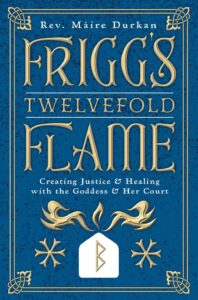
Devotees of Frigg, this one is for you: the newest work from Reverend Máire Durkan, Frigg’s Twelvefold Flame: Creating Justice & Healing with the Goddess and Her Court, is now available from Llewellyn! I am appreciative of the publisher providing a review copy, so I can share this incredible book with you.
If you have had the good fortune to attend a Frigg-centered ritual with Durkan, you know the depth and intensity of her connection with the All-Mother and her court, and the many facets Frigg presents to us. This new book provides a thorough discussion of Frigg and the members of her Sovereign Council, grounded both in research and in Durkan’s practice of many years. Those who have read her prior work on Frigg, Circle of Frith – A Devotional to Frigg and Her Handmaidens published by The Troth in 2021, will find some familiar content, but this new book happily is not just a rewrite of the earlier work. Durkan presents Frigg and her retinue not just as historical goddesses, but also as living, active, passionate forces who are strong allies in modern times as we work to make the world a better place for all people.
The book opens with an introduction to Frigg and her lore. Durkan provides an explanation of key terms, explains personal gnosis, and discusses the concept of sacred activism.
The second section of the book looks at Frigg in multiple aspects, from All-Mother, to Queen, Beloved, Magick Worker, and Key-Keeper. For anyone not familiar with this multi-faceted goddess, this section is invaluable as a means to understanding Frigg’s role in the Norse pantheon and lore; those who have some knowledge of Frigg will be pleasantly surprised to learn more about her.
Not only does she discuss Frigg’s role in lore and historical matters, Durkan brings Frigg forward to our modern times, discussing how Frigg can be called upon in social justice and social healing work. Frigg is not an ethereal queen; she is here today, present with those doing the work to make the world a better place. “Frigg’s archetype of sovereign, mother, and wise protector resonates deeply in a time when bodily autonomy, racial justice, and trans rights are under attack. Her quiet strength offers a counternarrative to capitalist individualism, reframing caregiving, community building, and boundary setting as sacred acts of resistance.” (Page 66)
While motherhood and mothering have often been dismissed and devalued, and at the same time aggrandized as a means of controlling those who can bear children, Durkan insists (and I agree) that mothering is a gender-neutral activity. “In this context, mothering includes nurturing and protecting as well as empowering and advocating for others….Through our actions, we show that mothering is a powerful force for social change, capable of transforming communities and shaping a more inclusive and compassionate world.” (Page 84)
This section closes with a discussion of general correspondences, as well as ideas for honoring Frigg in daily activities and on holy days, as well as through social work and activism.
Durkan then presents each of the twelve member of Frigg’s retinue in Section Three. Even as someone who has done more than a bit of reading about Frigg and The Twelve, I learned new information about each of the goddesses.
My practice includes a relationship with Saga (for reasons which might be obvious), who is the first one featured. Reading a chapter about her written by someone who is also passionate about Saga and her work was an absolute delight. The power of stories to both preserve and to transform is remarkable. As Durkan notes: “An unshared story is like an unhealed wound, but in her name, we speak out, hold on, and weave stories into history.” (Page 162)
The other goddesses then appear in turn: Eir, Gefjun, Fulla, Sjöfn, Lofn, Vár, Vör, Syn, Hlín, Snotra, and Gná. We are given an introduction to the goddess in the lore, then ideas on working with her in our current era. Each has a list of vocations and professions associated with her, a set of correspondences (symbols, crystals, plants, and runes) to use in workings, and suggested offerings. Durkan also provides a prayer, a meditation, and a suggested ritual for each goddess, as well as a charge from the goddess and an affirmation to help the reader connect more closely.
Durkan suggests activities to honor each goddess, deepening the connection and taking it from personal practice to practical effect in the world. These range from fun things, such as dancing, to self-care suggestions such as “Take a nap!” (page 209) (one of my personal favorites), and ideas for community activities to create healing and promote justice and joy, such as organizing events where marginalized peoples can share their knowledge, history, and practices.
Durkan draws on her rich life experience as a birth midwife and death doula in this book, which gives it that much more authenticity and power. Throughout the book, Durkan maintains an excellent level of social awareness and inclusiveness in her language: she makes references to families of all types—extended, those with same-sex partners and parents, polyamorous families, and blended families of all kinds—as well as including Indigenous, BIPOC, and LGBTQIA+ persons in her discussions. All of these less traditional and marginalized groups are presented as simply a part of the fabric of life, and not as unusual case studies.
This book is a work of scholarship and also a work of hope. As Durkan reminds us, “You are never alone at the hearth!” (Page 296)
With Frigg and The Twelve at our sides, we can make this world a better place.

